
Please Note: This article is written for users of the following Microsoft Excel versions: 97, 2000, 2002, and 2003. If you are using a later version (Excel 2007 or later), this tip may not work for you. For a version of this tip written specifically for later versions of Excel, click here: Formatting a PivotTable.
You know that you can format cells in your worksheets by using the different tools on the Formatting toolbar, or by using the Cell option from the Format menu. Excel also allows you to format PivotTables using these same techniques. You should know, however, that the best way to format PivotTables is to use the AutoFormat feature. This is because whenever you manipulate the table or refresh the data, any explicit formatting you might have applied (using the Cell option from the Format menu) is eliminated by Excel. This limitation does not apply when you use the built-in AutoFormats.
To use the AutoFormat feature, select a cell in the PivotTable, and then choose AutoFormat from the Format menu. Excel displays the AutoFormat dialog box. (See Figure 1.)
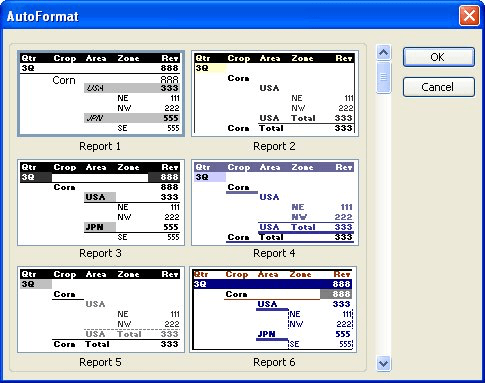
Figure 1. The AutoFormat dialog box.
Scroll through the available formats, and click the one you want to use. When you click the OK button, the desired format is applied to the PivotTable.
ExcelTips is your source for cost-effective Microsoft Excel training. This tip (2482) applies to Microsoft Excel 97, 2000, 2002, and 2003. You can find a version of this tip for the ribbon interface of Excel (Excel 2007 and later) here: Formatting a PivotTable.

Excel Smarts for Beginners! Featuring the friendly and trusted For Dummies style, this popular guide shows beginners how to get up and running with Excel while also helping more experienced users get comfortable with the newest features. Check out Excel 2019 For Dummies today!
Create a complex PivotTable and you may find that your system slows to a crawl. The reason for this may be due to the way ...
Discover MorePivotTables are great for digesting and analyzing huge amounts of data. But what if you want part of that data excluded, ...
Discover MoreIf you modify the data on which a PivotTable is based, you'll need to refresh the table so it reflects the modified data. ...
Discover MoreFREE SERVICE: Get tips like this every week in ExcelTips, a free productivity newsletter. Enter your address and click "Subscribe."
There are currently no comments for this tip. (Be the first to leave your comment—just use the simple form above!)
Got a version of Excel that uses the menu interface (Excel 97, Excel 2000, Excel 2002, or Excel 2003)? This site is for you! If you use a later version of Excel, visit our ExcelTips site focusing on the ribbon interface.
FREE SERVICE: Get tips like this every week in ExcelTips, a free productivity newsletter. Enter your address and click "Subscribe."
Copyright © 2026 Sharon Parq Associates, Inc.
 Please Note:
This article is written for users of the following Microsoft Excel versions: 97, 2000, 2002, and 2003. If you are using a later version (Excel 2007 or later), this tip may not work for you. For a version of this tip written specifically for later versions of Excel, click here:
Please Note:
This article is written for users of the following Microsoft Excel versions: 97, 2000, 2002, and 2003. If you are using a later version (Excel 2007 or later), this tip may not work for you. For a version of this tip written specifically for later versions of Excel, click here: 
Comments