
Please Note: This article is written for users of the following Microsoft Excel versions: 97, 2000, 2002, and 2003. If you are using a later version (Excel 2007 or later), this tip may not work for you. For a version of this tip written specifically for later versions of Excel, click here: Conditional Format that Checks for Data Type.
Joshua is trying to establish a conditional format that will alert a user that text data has been entered into a cell intended for numerical data or when numerical data has been input into a cell intended for text data.
A conditional format can be used to draw attention to when an improper value (text or numeric) has been entered in a cell, but a more robust approach might be to prohibit the improper value from being entered in the first place. This can be done with the data validation capabilities of Excel. These capabilities have been discussed, in detail, in other ExcelTips; more information can be found here:
http://excel.tips.net/E165_Data_Validation.html
Using data validation, you can specify the type and range of data permitted in a cell, along with how stringently you want that specification followed. If you prefer to not use data validation for some reason, you could set up a conditional format that would verify if the information placed in a cell is of the data type you want. Follow these steps:
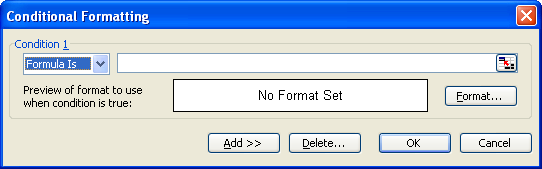
Figure 1. The Conditional Formatting dialog box.
     =ISTEXT(A1)
     =ISNUMBER(A1)
ExcelTips is your source for cost-effective Microsoft Excel training. This tip (6906) applies to Microsoft Excel 97, 2000, 2002, and 2003. You can find a version of this tip for the ribbon interface of Excel (Excel 2007 and later) here: Conditional Format that Checks for Data Type.

Best-Selling VBA Tutorial for Beginners Take your Excel knowledge to the next level. With a little background in VBA programming, you can go well beyond basic spreadsheets and functions. Use macros to reduce errors, save time, and integrate with other Microsoft applications. Fully updated for the latest version of Office 365. Check out Microsoft 365 Excel VBA Programming For Dummies today!
One of the powerful features of Excel is the ability to format a cell based on the contents of that cell or another. It ...
Discover MoreIf you want to apply a conditional format to data imported into Excel from Access, you may run into some difficulties ...
Discover MoreIf you have conditional formatting applied in a worksheet, the formulas in those formats may not be as secure as you ...
Discover MoreFREE SERVICE: Get tips like this every week in ExcelTips, a free productivity newsletter. Enter your address and click "Subscribe."
There are currently no comments for this tip. (Be the first to leave your comment—just use the simple form above!)
Got a version of Excel that uses the menu interface (Excel 97, Excel 2000, Excel 2002, or Excel 2003)? This site is for you! If you use a later version of Excel, visit our ExcelTips site focusing on the ribbon interface.
FREE SERVICE: Get tips like this every week in ExcelTips, a free productivity newsletter. Enter your address and click "Subscribe."
Copyright © 2026 Sharon Parq Associates, Inc.
 Please Note:
This article is written for users of the following Microsoft Excel versions: 97, 2000, 2002, and 2003. If you are using a later version (Excel 2007 or later), this tip may not work for you. For a version of this tip written specifically for later versions of Excel, click here:
Please Note:
This article is written for users of the following Microsoft Excel versions: 97, 2000, 2002, and 2003. If you are using a later version (Excel 2007 or later), this tip may not work for you. For a version of this tip written specifically for later versions of Excel, click here: 
Comments