
Please Note: This article is written for users of the following Microsoft Excel versions: 97, 2000, 2002, and 2003. If you are using a later version (Excel 2007 or later), this tip may not work for you. For a version of this tip written specifically for later versions of Excel, click here: Contingent Validation Lists.
The data validation capabilities in Excel are quite handy, particularly if your worksheets will be used by others. When developing a worksheet, you might wonder if there is a way to make the choices in one cell contingent on what is selected in a different cell. For instance, you may set up the worksheet so that cell A1 uses data validation to select a product from a list of products. You would then like the validation rule in cell B1 to present different validation lists based on the product selected in A1.
The easiest way to accomplish this task is in this manner:
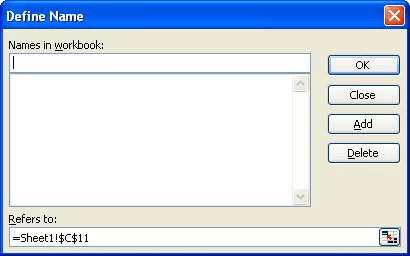
Figure 1. The Define Name dialog box.
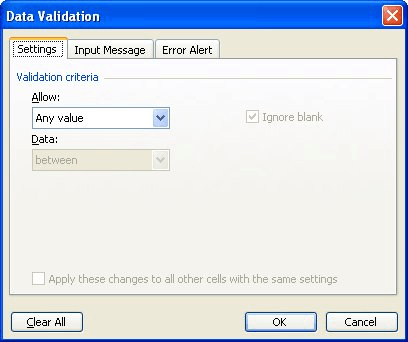
Figure 2. The Data Validation dialog box.
That's it. Now, whatever is chosen in cell A1 dictates which list is presented in cell B1.
ExcelTips is your source for cost-effective Microsoft Excel training. This tip (3195) applies to Microsoft Excel 97, 2000, 2002, and 2003. You can find a version of this tip for the ribbon interface of Excel (Excel 2007 and later) here: Contingent Validation Lists.

Excel Smarts for Beginners! Featuring the friendly and trusted For Dummies style, this popular guide shows beginners how to get up and running with Excel while also helping more experienced users get comfortable with the newest features. Check out Excel 2019 For Dummies today!
When you copy a worksheet and then need to make changes to information in that worksheet (such as changing month names), ...
Discover MoreThere are a few editing tricks you can apply in Excel the same as you do in Word. Selecting a word from the text in a ...
Discover MoreWant to convert the text in a cell so that it wraps after every word? You could edit the cell and press Alt+Enter after ...
Discover MoreFREE SERVICE: Get tips like this every week in ExcelTips, a free productivity newsletter. Enter your address and click "Subscribe."
There are currently no comments for this tip. (Be the first to leave your comment—just use the simple form above!)
Got a version of Excel that uses the menu interface (Excel 97, Excel 2000, Excel 2002, or Excel 2003)? This site is for you! If you use a later version of Excel, visit our ExcelTips site focusing on the ribbon interface.
FREE SERVICE: Get tips like this every week in ExcelTips, a free productivity newsletter. Enter your address and click "Subscribe."
Copyright © 2026 Sharon Parq Associates, Inc.
 Please Note:
This article is written for users of the following Microsoft Excel versions: 97, 2000, 2002, and 2003. If you are using a later version (Excel 2007 or later), this tip may not work for you. For a version of this tip written specifically for later versions of Excel, click here:
Please Note:
This article is written for users of the following Microsoft Excel versions: 97, 2000, 2002, and 2003. If you are using a later version (Excel 2007 or later), this tip may not work for you. For a version of this tip written specifically for later versions of Excel, click here: 
Comments