
Please Note: This article is written for users of the following Microsoft Excel versions: 97, 2000, 2002, and 2003. If you are using a later version (Excel 2007 or later), this tip may not work for you. For a version of this tip written specifically for later versions of Excel, click here: Using Multiple Print Settings.
If you have multiple areas that you print in a worksheet, you may get tired of repeatedly specifying what area you want to print and then printing it. Such a task is well suited to being done with a macro. The macro can take care of specifying a print area and then actually printing the information.
For instance, let's assume that you have two print ranges defined in your worksheet: Range1 and Range2. Further, Range1 should be printed in portrait orientation and Range2 should be printed in landscape orientation. The following macros can be used to print each of the print ranges:
Sub PrintRange1()
    ActiveSheet.PageSetup.PrintArea = Range("range1").Address
    ActiveSheet.PageSetup.Orientation = xlPortrait
    ActiveWindow.SelectedSheets.PrintOut
End Sub
Sub PrintRange2()
    ActiveSheet.PageSetup.PrintArea = Range("range2").Address
    ActiveSheet.PageSetup.Orientation = xlLandscape
    ActiveWindow.SelectedSheets.PrintOut
End Sub
These are very simple macros, but you get the idea—all you need to do is set up the print job in the macro, and then print from the macro itself. You could even attach the macros to toolbar buttons or to a menu option, as described in other issues of ExcelTips.
If you prefer to not use macros, you could also use the custom views feature of Excel. Simply set the print area, orientation, margins, and other settings desired. Then define this as a custom view. To define a custom view, follow these steps:
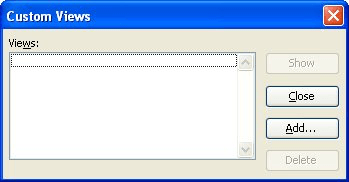
Figure 1. The Custom Views dialog box.
You can continue to define and save additional views, as desired. Your custom views are saved with your workbook, and you can later use them to print what you want. (Just display the custom view and then print your worksheet.)
Note:
ExcelTips is your source for cost-effective Microsoft Excel training. This tip (2703) applies to Microsoft Excel 97, 2000, 2002, and 2003. You can find a version of this tip for the ribbon interface of Excel (Excel 2007 and later) here: Using Multiple Print Settings.
Best-Selling VBA Tutorial for Beginners Take your Excel knowledge to the next level. With a little background in VBA programming, you can go well beyond basic spreadsheets and functions. Use macros to reduce errors, save time, and integrate with other Microsoft applications. Fully updated for the latest version of Office 365. Check out Microsoft 365 Excel VBA Programming For Dummies today!
If your worksheet, when printed, requires more than a single page to print, you may want to only print a range of the ...
Discover MoreWant to print out the fastest possible copy of your worksheet? You do so by printing a draft, discussed in this tip.
Discover MoreExcel allows you to specify certain rows or columns that will be repeated on the pages of a printout. Here's how to set ...
Discover MoreFREE SERVICE: Get tips like this every week in ExcelTips, a free productivity newsletter. Enter your address and click "Subscribe."
There are currently no comments for this tip. (Be the first to leave your comment—just use the simple form above!)
Got a version of Excel that uses the menu interface (Excel 97, Excel 2000, Excel 2002, or Excel 2003)? This site is for you! If you use a later version of Excel, visit our ExcelTips site focusing on the ribbon interface.
FREE SERVICE: Get tips like this every week in ExcelTips, a free productivity newsletter. Enter your address and click "Subscribe."
Copyright © 2026 Sharon Parq Associates, Inc.
 Please Note:
This article is written for users of the following Microsoft Excel versions: 97, 2000, 2002, and 2003. If you are using a later version (Excel 2007 or later), this tip may not work for you. For a version of this tip written specifically for later versions of Excel, click here:
Please Note:
This article is written for users of the following Microsoft Excel versions: 97, 2000, 2002, and 2003. If you are using a later version (Excel 2007 or later), this tip may not work for you. For a version of this tip written specifically for later versions of Excel, click here: 
Comments